Pig Health: A Complete Guide to Piglet Gut Health, Nutrition and Disease Prevention
Explore pig health, piglet gut health, swine nutrition, gut microbiota, probiotics, biosecurity and new research approaches for healthy pig production.
Pig health is a major focus in modern swine production, with nutrition, gut microbiota, farm hygiene, biosecurity and environmental management all contributing to healthy growth and productive pig herds. For young animals, maintaining piglet health is particularly important because the transition from birth to weaning involves major changes in nutrition, environment and intestinal development.Recent research increasingly highlights the relationship between pig gut health, intestinal microbiota, nutrition and animal performance. Understanding these connections can help researchers, veterinarians and pig producers develop more effective approaches to swine health management.

What Is Pig Health?
Pig health is influenced by multiple interconnected factors, including:
- Nutrition and feed quality
- Gut health and intestinal microbiota
- Environmental conditions
- Farm hygiene and sanitation
- Biosecurity practices
- Weaning management
- Immune function
- Genetics and breeding
- Stress and animal welfare
- Monitoring and veterinary management
Rather than focusing on a single factor, modern pig health management increasingly considers the interaction between the animal, its environment, diet and microorganisms.
Why Is Piglet Health So Important?
The early stages of a pig's life are important for growth and development. The weaning period can be particularly challenging because piglets experience dietary, environmental and social changes at the same time.
Research has linked weaning stress with changes in feed intake, intestinal function and gut microbiota. Poor management during this period can contribute to digestive disturbances, reduced growth performance and post-weaning diarrhea.
Supporting piglet health therefore involves creating appropriate conditions before, during and after weaning.
Pig Gut Health and the Gut Microbiota
One of the most important areas of current swine health research is the pig gut microbiome.
The gastrointestinal tract contains a complex microbial community that interacts with intestinal tissues and contributes to digestion, metabolism and immune regulation. A balanced pig gut microbiota is associated with intestinal stability and normal gut function.
During weaning, changes in diet and environmental conditions can alter the composition of the microbiota. Research using 16S rRNA sequencing has identified differences in microbial profiles between piglets that remain resilient after weaning and those that develop post-weaning diarrhea.
This has made gut microbiome analysis, microbiota profiling and molecular research increasingly valuable tools for understanding pig health.

How Does Nutrition Affect Pig Health?
Nutrition is one of the major components of pig health management. Feed provides the energy, amino acids, minerals and other nutrients required for growth and normal physiological function.
For piglets, nutritional strategies can also influence intestinal development and the gut microbiome. Researchers are investigating approaches involving:
- Functional amino acids
- Prebiotics
- Probiotics
- Synbiotics
- Postbiotics
- Feed enzymes
- Minerals and trace elements
- Specialized piglet diets
- Creep feeding
- Precision nutrition
Current research is particularly interested in how dietary components interact with the intestinal barrier, gut microbiota and host responses.

Probiotics and Pig Gut Health
Probiotics for pigs are another active area of research. Beneficial microorganisms may influence the composition and activity of the intestinal microbiota and may support intestinal function.
Studies have investigated probiotic supplementation in piglets in relation to gut microbiota, intestinal barrier function, growth performance and immune parameters.
However, probiotic effects can depend on the microbial strain, dosage, animal age, diet and farm environment. For this reason, research into piglet probiotics and gut microbiome modulation remains an important field in animal biotechnology.

Biosecurity and Pig Health
Good farm biosecurity is another essential component of swine health management. Biosecurity aims to reduce the introduction and spread of infectious agents within a pig production system.
Important areas can include:
- Controlled farm access
- Cleaning and disinfection
- Appropriate pig movement
- Isolation procedures
- Equipment hygiene
- Monitoring animal health
- Appropriate vaccination programs
- All-in/all-out management where applicable
Research has shown that sanitation and biosecurity practices can influence piglet performance and intestinal health.
A biosecurity program should be adapted to the specific farm, production system and risk factors rather than treated as a universal checklist.
Pig Health and Post-Weaning Diarrhea
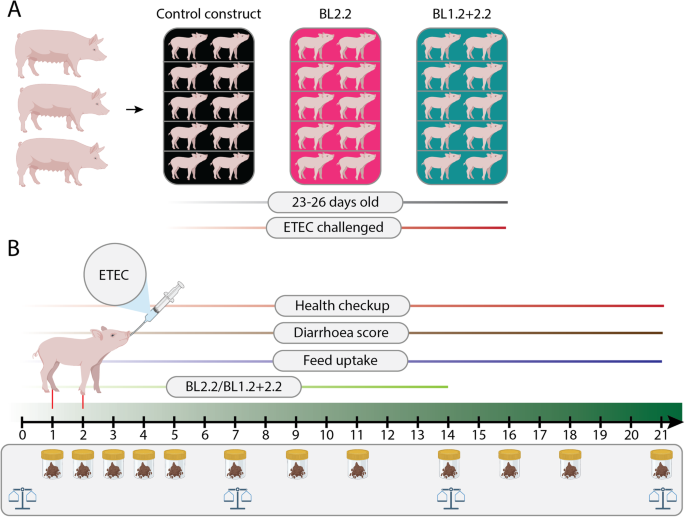
Post-weaning diarrhea in piglets remains an important research topic in swine production. The condition is influenced by several interacting factors, including intestinal microbiota, nutrition, environmental stress and exposure to enteric pathogens.
Recent research is investigating whether microbiome profiles can help identify piglets that are more resilient to post-weaning diarrhea. A 2026 study, for example, examined fecal microbiome profiles and potential biomarkers associated with resilience in piglets.
These approaches demonstrate how sequencing and microbiome research may contribute to a more detailed understanding of piglet gut health.
New Research Directions in Pig Health
The field of pig health research is moving toward more integrated approaches combining animal science, microbiology, nutrition and molecular biology.
Researchers are increasingly using:
16S rRNA sequencing : to characterize bacterial communities.
Metagenomics : to investigate microbial genes and functional potential.
Metabolomics : to study metabolites produced by the host and microbiota.
Multi-omics approaches : to connect microbial, molecular and physiological data.
Biomarker discovery : to investigate biological indicators associated with intestinal health and resilience.
These technologies can provide researchers with a deeper view of the biological processes underlying swine health and piglet gut health.

The Future of Pig Health Management
The future of pig health research is increasingly focused on prevention, resilience and precision management. Instead of looking at nutrition, microbiota, environment and biosecurity separately, researchers are investigating how these factors interact.
Emerging areas include precision nutrition, microbiome-based research, probiotic development, intestinal biomarkers, molecular diagnostics and multi-omics analysis.
For pig producers and researchers, understanding these interactions may support more targeted approaches to maintaining healthy animals, improving production efficiency and reducing avoidable health challenges.
Pig Health Research and Scientific Resources
As research into pig health, swine health, piglet gut health and the pig microbiome continues to expand, access to reliable scientific products and laboratory resources is increasingly important.
Research tools for microbiology, molecular biology, genomics, immunology, biomarker research and animal science can support laboratory investigations into the biological mechanisms underlying pig health.
Gentaur provides access to a broad range of research products and scientific resources that can support laboratories working across biotechnology, molecular biology and life science research.

Conclusion
Healthy pig production depends on multiple interconnected factors. Pig nutrition, gut microbiota, intestinal health, biosecurity, environmental management and piglet care all contribute to overall swine health.
With advances in sequencing, microbiome analysis, metabolomics and other molecular technologies, researchers are gaining new opportunities to investigate pig health at a deeper biological level. These developments are helping move the field toward more data-driven approaches to piglet health, gut health and sustainable swine production.